
How to Take Notes During a Phone Call (and Read Them Back)
Write five lines, read the numbers back before you hang up, then confirm in writing. The rule pilots and nurses rely on, sized for everyday calls.

On this page
A kitchen remodeler quotes $4,800 from his truck, phone pinned to his shoulder. Two weeks later the homeowner asks whether that price included the backsplash tile, and all he remembers saying is "probably." Pilots on the radio and nurses taking orders by phone can't run on "probably," so they follow one rule: write it down, then read it back before the call ends. Here's how to take notes during a phone call their way, on one index card.
Quick answer
To take notes during a phone call, fill in a 5-line call card: who and when, what you agreed, the numbers, the next step and its owner, and the deadline. Before you hang up, read the card back and wait for a yes. Then confirm by text or email. To record, ask first. Recording laws differ by state and country. Tell everyone on the call that you're recording, and get their consent where the law requires it.
How do you take notes during a phone call?
To take notes during a phone call, fill in five lines as you listen: who and when, what you agreed, the numbers, the next step and who owns it, and the deadline. Then read the numbers and decisions back before you hang up. That's the 5-line call card. Each line has one job:
- Who and when. Name, company, and the date and time of the call.
- What we agreed. One line per decision: what's in, and what's out.
- The numbers. Prices, sizes, quantities and dates, written as digits the moment you hear them.
- Next step, and who owns it. A name, always ("Me" counts). "We" has never once owned a next step.
- Deadline. A day and a date, not "soon."
You don't need to write faster. You need five blanks, filled with nouns and digits, not sentences. Have the card out before you dial and put the call on speaker, so both hands are free. Anything fuzzy gets a ? in the margin: that's your read-back list.
Phone call notes template: copy this card
1. Who and when: ____ (name, company, date, time)
2. What we agreed: ____ (in, out)
3. The numbers: ____ (in digits)
4. Next step, and who owns it: ____
5. Deadline: ____ (day and date)
Read back: Y / ?
What is the read-back technique?
The read-back technique means reading your notes aloud to the person who gave you the details, then waiting for a yes or a correction. Pilots use it for air traffic clearances (FAA) and hospital staff for orders given by phone (NCC MERP), because it can catch a misheard number before anyone acts on it.
The FAA's Aeronautical Information Manual (section 4-4-7) tells pilots flying under instrument flight rules to "make a written record of your clearance." Reading back the numbers "serves as a double check" for the moment "a number is either 'misheard' or is incorrect." In hospitals, whoever takes a spoken medication order "should write down the complete order, then read it back, and receive confirmation," says the National Coordinating Council for Medication Error Reporting and Prevention (NCC MERP).
Your takeout order gets a read-back. The $4,800 kitchen didn't. A 2011 commentary on PSNet, the patient-safety site of the federal Agency for Healthcare Research and Quality (AHRQ), says read-backs matter most with "background noise," "sound-alike letters or words," and numbers that "might be missed or reversed." In other words, a quote from a truck.
The script is one sentence: "Let me read that back," then the numbers and decisions in the order you heard them.
Sample notes, the remodeler's read-back: "Let me read that back: $4,800 for new cabinets and install, done by Friday, November 13, backsplash tile not included." Beth: "Right. No tile."
One honest limit, from the same commentary: "Read-backs do not guarantee safety." A read-back can't catch what nobody said out loud. The confirming text can.
Read back or repeat back: what's the difference?
The difference is whether you wrote it down first. A read-back is read from your notes; a repeat-back can come from memory. In aviation the two words blur: the FAA's Pilot/Controller Glossary defines read back as "Repeat my message back to me."
Healthcare draws the line at the pen. NCC MERP accepts "stating back the order (without writing the order down first)" only in "situations such as a sterile environment and/or emergencies." A phone quote is neither, so read from your card, not your memory.
What should you write down when someone gives you a quote on the phone?
When someone gives you a quote on the phone, write down the price in digits, what it includes and what it leaves out, the materials, the completion date, and when the written quote will arrive. Then get it in writing: the FTC tells homeowners that a contract should include "any promises made during conversations or calls."
The FTC's checklist for a written estimate covers most of that list: "a description of the work to be done, materials, completion date, and the price."
On the card, that's three lines: what's in and out on line 2, the price and finish date on line 3, the day the written quote arrives on line 5.
Back in the truck, one Out line would have settled the tile question in two words. If you're the one asking, "probably" gets one follow-up: "Is that a yes?" If you're the one quoting, don't say it. "Probably" is not a number.
Is a phone quote binding? We make notebooks, not legal opinions, so we won't guess (this is general information, not legal advice). Get it in writing and you may never have to find out.
Which words get misheard on a phone call?
Numbers that sound alike, like fifteen and fifty, get misheard on phone calls, and so do long numbers and names with two spellings. Other words are heard fine and still misunderstood: a time with no time zone, a date like "next Tuesday," and hedges like "probably" and "including," where a guess sounds like a promise.
Each fix below says where it comes from. The unsourced ones are our own rules of thumb, and we label them that way.
| Said on the phone | The fix |
|---|---|
| "fifteen" or "fifty"?Sound-alike numbers, like thirteen and thirty | Say the digits: "one five," "five zero."NCC MERP |
| Order, account or phone numbersLong strings get garbled | Say each digit: "four four one seven."FAA AIM 4-2-8 |
| "$4,800"Long numbers get dropped or reversed | Write the digits, then read them back.AHRQ PSNet, adapted |
| "at 3"Which time zone? | Name it: "3 p.m. Central."FAA AIM 4-2-12 |
| "next Tuesday"Which Tuesday? | Say the date: "Tuesday, October 20."Our rule of thumb |
| "probably," "should be"A guess sounds like a promise | Ask "Is that a yes?" Write the answer.Our rule of thumb |
| "including"What's in, and what's out? | List both: "In: install. Out: tile."Our rule of thumb |
| Sarah or Sara, Jon or JohnSound-alike spellings | Spell it: "S as in Sam."NCC MERP, adapted |
Examples to watch for, not measured error rates. "Our rule of thumb" means no source; "adapted" means we applied the source's reason to a new case. Sources checked October 9, 2026: NCC MERP, FAA AIM 4-2-8 and 4-2-12 ("pronouncing each digit"), AHRQ PSNet ("missed or reversed").
Pilots go further. The FAA's pronunciation table (AIM 4-2-7) has them say nine as "NIN-er" and five as "FIFE." On a quote call, digits one at a time are plenty.
How do you confirm a phone conversation in writing?
Confirm a phone conversation in writing with a short text or email, sent the same day, that repeats what was agreed, the numbers, the next step and the deadline. End by asking the other person to reply if anything is off.
A confirming text covers the read-back's blind spot: Beth checks $4,800 with her eyes, not through a phone speaker.
Sample notes, the remodeler's text: "Thanks, Beth. Confirming: $4,800 for new cabinets and install, done by Friday, November 13. Backsplash tile is not included. I'll email the written quote by Friday, October 9. Reply if anything's off."
Template: email confirming a phone conversation
Subject: Confirming our call on [date]: [topic]
Thanks for the call today. Here's what I wrote down: [what we agreed].
Numbers: [the numbers].
Next step: [who] will [what] by [day and date].
If anything here is off, reply and I'll fix it.
The last line does the work. A reply is a yes you can search for in March. Silence proves nothing.
Sample notes, two weeks later: Beth asks about the tile. The answer is in her own messages, right above her reply: "Yes, got it."
If the call settles something you'll argue about in six months, build a decision log from handwritten notes.
Should you record the call or just take notes?
For most calls, a written card and a read-back are enough. Record as well when the call is long or full of numbers, and everyone on it agrees. Keep writing the card either way: the recording keeps everything, and the card keeps what mattered.
Pick by the kind of call. Every "record" below assumes everyone on the call agrees.
If it's a short call with one or two numbers
Card and read-back
Five lines and one "Let me read that back" cover it.
If it's a quote, a price or a scope of work
Card, read-back and a confirming text
Record too, if everyone agrees. The FTC advises putting promises made on calls in the written contract.
If it's a long call with many details
Record, if everyone agrees, plus the card
A recording catches what you can't write fast enough.
If it's a one-to-one call and they agree
Your phone's recorder, plus the card
Where it's offered. The iPhone and Android limits are below.
If they say no to recording
Don't record. No means notes.
Card, read-back and a confirming text still leave a written record.
If it's a group call, or you're in the EU on an iPhone
The card
The iPhone records only calls with "one other person," and not in 19 places Apple lists.
The card is in every answer for a reason: it's the one option that never needs anyone's permission.
How do you ask to record a phone call?
Ask at the start, in one sentence: "Mind if I record this so I get the details right?" If they say yes, record, and write the card anyway.
The line gives a reason and leaves room for a no. If someone joins the call later, ask again. On an iPhone the recording notice "replays periodically during the call," per Apple's Personal Safety guide, so the phone will remind them more than once. Ask anyway.
If the answer is no, the rule is No means notes: don't record, and let the card do the work. It was doing most of it anyway.
Consent
Recording laws differ by state and country. Tell everyone on the call that you're recording, and get their consent where the law requires it.
This is general information, not legal advice. For the rules in each state, see the Reporters Committee for Freedom of the Press recording guide (checked October 9, 2026).
Can your phone already record calls?
Yes, many phones record calls without another app. The iPhone's Phone app (iOS 27) and the Google Phone app on Android both do it, and both announce the recording to the other person. The fine print, checked October 9, 2026:
iPhone: notice
Both hear it
"Both call participants hear an audio notice," and it "replays periodically during the call." Apple
iPhone: limits
One other person
Calls with "one other person" only. Not available in 19 listed places, including the European Union. Apple
Android: notice
Both hear it
Both parties are notified when recording starts and when it stops. Google
Android: limits
Some phones
Only certain devices and carriers: non-Pixel phones on Android 9 and up, Pixel 6 and up on Android 14 and up. Not in all countries or regions. Google
If your phone records calls where you live and the other person says yes, you already own a call recorder.
AI note takers on a laptop can do it too, with a workaround: Jamie's own guide has you put the call on speaker next to the laptop. The same consent rule applies, and so do these 10 privacy questions to ask before you use an AI note taker.
Do you need a smart pen or a call recorder for phone notes?
No. A pen and an index card do the job. A smart pen earns its place after the call, when you want the card searchable and line 4 on your task list. A recorder earns its place when the call is too long to write down and everyone agrees to be recorded.
XNote Write is a smart pen and notebook: you write with real ink on XNote paper and your handwriting appears in the XNote app, searchable and understood by AI. The pen captures handwriting only on XNote paper: XNote notebooks, or pages you print from the XNote app on US Letter or A4, on a laser printer or at a print shop such as FedEx Office or Staples. (New to this? Here's how a smart pen works.) Before you buy one, our XNote Write review starts with what owners complain about.
The payoff comes after you hang up. Line 4 is a to-do, and the XNote app lists written to-dos as tasks. Here is a real one, from a meeting page rather than Beth's call:


XNote Write
Write the call card in ink. To-dos and dates you write become tasks and calendar events.
AI chat is included, with usage limits.
See XNote WriteThe pen has no microphone, so XNote Write captures only what you write. The XNote app can't record phone calls; XNote Voice can. XNote Voice is a standalone recorder that attaches magnetically to the back of a phone, and it records both sides of the conversation. Your calls go to the XNote app for a transcript and a summary.
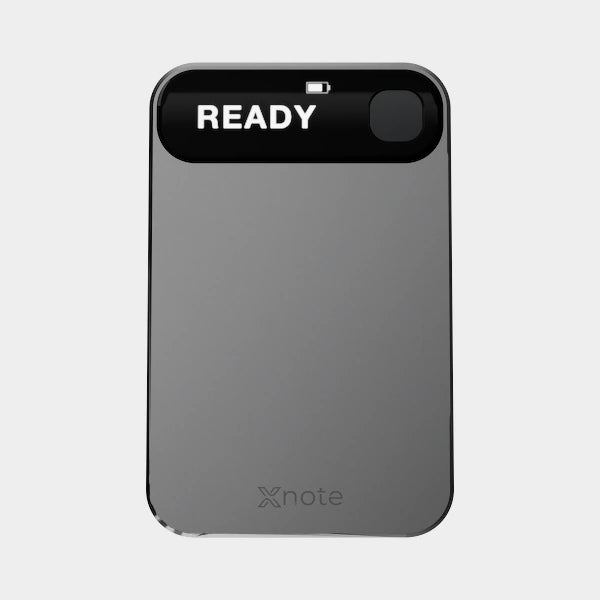
Pre-production design. Final product may differ.
XNote Voice
For the calls you need to get right: customer calls, quotes, appointments, anything agreed by phone.
XNote Voice is on pre-order at $159, with target shipping in Q4 2026 (checked October 9, 2026).
Recording laws differ by state and country. Tell everyone on the call that you're recording, and get their consent where the law requires it.
See XNote VoiceEach works on its own with the XNote app. There's no combined offer, so buy only the one your calls need. And when everyone agrees to a recording, the split is simple: record the call, write down what matters.
You don't need XNote if
- A sticky note and a confirming text already cover your few calls a week. Keep doing that.
- You want the pen to record the call. It can't: the pen has no microphone.
- You need a recorder today. Your phone's own Phone app may record calls too.
- They say no to recording. Then no device is the answer. The card is.
Phone call notes: what else people ask
Is there a phone call notes template?
Yes: the 5-line call card is the template. Copy its lines onto an index card: who and when, what we agreed, the numbers, the next step and its owner, and the deadline.
For searchable paper, the Log Sheet and Meeting Notes layouts print free from the XNote app on US Letter or A4 paper with a laser printer; you pay only for your own paper and toner. Inkjet prints can't be read by the pen. No laser printer? A print shop such as FedEx Office or Staples can print them for a per-page fee (what that costs): ask for laser output and try one test page with the pen first. With XNote Write and the app open and connected, your writing appears in the app as you write.
Can AI take notes on a phone call?
Yes, from a recording. An iPhone puts a recorded call's transcript in the Notes app, in select regions and languages, plus a summary with Apple Intelligence. Google Voice's "Take notes for me" does both on Standard and Premier business plans, in English (announced June 16, 2026). The XNote app can't record phone calls; XNote Voice can. Recording laws differ by state and country. Tell everyone on the call that you're recording, and get their consent where the law requires it.
Do I have to tell someone I'm recording a call?
Recording laws differ by state and country. Tell everyone on the call that you're recording, and get their consent where the law requires it. This is general information, not legal advice. The iPhone and the Google Phone app announce a recording, but an announcement doesn't replace asking: Apple says to make sure the other person "gives explicit consent to be recorded." For each state's rules, see the RCFP recording guide.
How do you document a phone conversation for your records?
Write a call card during the call, with the date and time on line 1. Send a confirming text or email the same day. Then file the card, your message and any reply together with the job or the client: what you heard, what you sent, and what they said back.
How do you take notes when someone talks fast?
Write nouns and digits, not sentences, and put a ? beside anything you missed. Ask them to slow down for the numbers: "Can you give me that one digit at a time?" Before you hang up, read back every line marked ?, in the order you heard it. Then send a confirming text the same day, so they can correct anything you still got wrong.
Sources and method
All sources checked October 9, 2026. The remodeler, Beth Ortiz and their call are sample notes written for this guide. We did not test call recording on any phone, and no source we found measures how often numbers are misheard on everyday calls, so "Our rule of thumb" means exactly that.
- FAA Aeronautical Information Manual 4-4-7, 4-2-7, 4-2-8, 4-2-12 and Pilot/Controller Glossary (effective July 9, 2026)
- NCC MERP, verbal medication orders (revised May 1, 2015)
- Henriksen and Hall, "Say It Again," AHRQ PSNet (June 1, 2011)
- FTC, How To Avoid a Home Improvement Scam (updated July 2022)
- Apple iPhone User Guide (iOS 27) and Personal Safety guide
- Google Phone app Help and Google Workspace Updates (June 16, 2026)
- RCFP recording guide (no page date)
- Jamie, AI note takers for phone calls (September 23, 2025)
- XNote Voice page (product lines and pre-order status)
Last updated October 2026. Facts checked October 9, 2026.