The Margin Notes

The Tablet Felt Like the Middle Path. Then a Consultant Checked the Numbers.

June 7, 2026 at 9:04 am EDT
I brought a tablet and stylus into client meetings for a full quarter because it felt like the smart compromise between the laptop ban and paper. My close rate quietly moved the wrong way. It took me two years and a Sunday podcast to understand the reason was not my pitch. It was the glass.  — A management consultant, twelve years in client-facing work (name withheld for professional discretion)
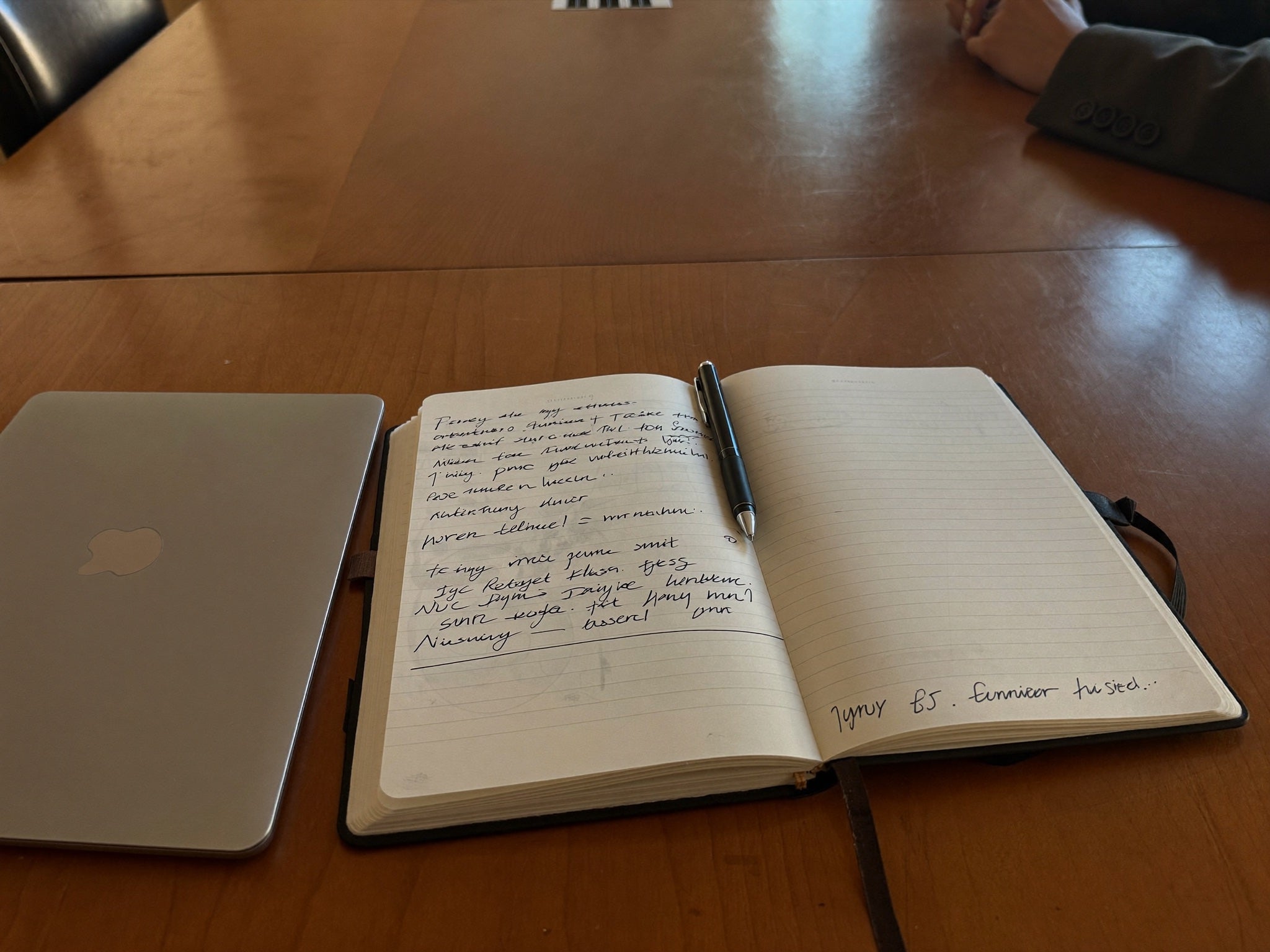
A leather notebook and pen on a meeting table beside a closed tablet
See If the $199 Starter Set Is Still Available

Click above to confirm the 30-day return window is still being offered.

The Compromise Felt Right. The Meetings Did Not.

For a full quarter I carried a tablet and a stylus into every client meeting, because it felt like the smart middle path. The laptop was effectively banned in the room, paper felt like a step backward, and the tablet seemed to be the obvious answer. The handwriting motion was there. The digital deliverable arrived without retyping. The marketing had been good enough that I never questioned the trade.

And yet the meetings felt slightly off in a way I could not put into words. Nothing I could point to. Nothing I could have defended out loud. Just a quiet sense that the room was a little colder than it used to be when I wrote on paper.

I told myself I was imagining it. Then I stopped being able to.

By Week Nine I Had Run the Experiment on Myself.

By week six I noticed that the close rate on three pitches in a row had moved in the wrong direction. I had not changed anything else. Same team. Same pricing band. Same client tier. The only consistent new variable was the tablet.

I told myself it was noise. The sample was too small. There were a thousand other things it could have been.

So by week nine I did the thing my job had trained me to do. I ran the experiment. Three tablet meetings in a row, then three back on the notebook, then two more on the tablet. The close rate moved back up the moment I returned to paper, and slipped again the moment I picked the stylus back up.

I still had no language for it. The tablet was handwriting. The motion was identical. The page on the screen looked like the page in the notebook. There was no obvious reason a glass screen should behave any differently in a client's eyes. But the clients across the table were clearly responding to something I could not yet name.

For Two Years I Chose Paper and Could Not Say Why.

After that quarter I quietly went back to paper and stayed there. I also spent two years unable to explain the decision to anyone.

A junior partner asked me about the tablet she was about to buy. I told her the screen was costing her something. She asked what. The best I could manage was that the meetings felt different and the numbers had moved. She bought it anyway, and her numbers moved in the same direction mine had.

A colleague asked what setup I was using these days, and the answer that came out was vague and a little embarrassing. The room responds differently when you write on paper, somehow.

I knew what I had seen. I just had no idea why it was true.

"The motion looked exactly like handwriting. But a stylus on glass may simply not land in the brain the way a pen on paper does."— The reframe that finally gave me the words

The Reason Was in the Neurology, Not the Pitch.

It was a Sunday morning, on a podcast, that I finally got the words I had been missing for two years.

The episode walked through two studies. A 2014 paper by Mueller and Oppenheimer at Princeton found that students who took notes by hand outperformed students typing on laptops on conceptual recall a week later. A separate EEG study out of Norway observed different patterns of brain activation when people wrote by hand versus when they typed.

The interpretation was that writing by hand on physical paper appears to engage motor and language regions more fully than typing does. Typed strokes are uniform, the motor planning is thinner, and the encoding may simply be shallower.

Then came the part I had been waiting two years to hear. Some researchers have argued the same logic may extend to writing on a glass screen with a stylus. The motion looks like handwriting, but the resistance of a pen against real paper, the slight grain of the page, the way real ink absorbs into the fiber, appears to be part of what the brain uses to encode the moment. Take the paper away and the encoding may quietly change, even when the gesture looks the same.

My instinct had a frame. The tablet may have been failing for a reason as specific as the patterns researchers have watched on a scan.

Why Every Modern Option Put the Screen Back in the Room.

Once I saw it, I could not unsee why the whole shelf had let me down.

The stylus tablets put a glass screen right back on the table, the exact surface the research suggested might be the problem. The note apps wanted me to stop writing by hand altogether and type. The voice recorders captured what was said but asked me to put the pen down to use them.

Each one solved a slice and called it the answer. Not one of them was built to let me keep a real pen on real paper and still walk out with a clean digital record.

That was the gap. And nobody selling a screen has any reason to point at it.

I Went Looking for the One Thing Nobody Was Selling.

That night I went searching for something that would let me keep writing the way I had always written, real pen on real paper, and still hand a client a clean deliverable on Friday.

Most of what came back was the same two shelves. Stylus tablets that put the glass screen back in the room, and apps that wanted me to abandon the pen. After about two hours I found one thing built on the opposite premise. A real pen and a real notebook, with the digital side handled quietly in the background.

It was called XNote. A real pen, real ink, and a real notebook that looks and feels like the ones I had used for years. None of the cold slide of glass. Except every line I write now shows up on my phone the moment I lift the pen, already turned into clean, searchable text beside my own page.

If I record a meeting through the companion app, the audio and my handwritten notes are kept together on one timeline, with an AI summary that reads both. The pen and the paper stayed exactly the same. Only the disappearing stopped. I ordered it before I could talk myself out of it.

The First Meeting Ran Like Every Paper Meeting Had.

The first client meeting I took the new setup into ran exactly the way every paper meeting had run for two years. Same notebook posture. A real pen in my hand. The laptop closed. The tablet in the bag, never coming out.

The only difference was invisible to everyone but me. By the time I sat down afterward, the Friday deliverable was already drafting itself in the background, the quotes sitting next to the pages where I had written them.

I kept waiting for the catch, for the moment it would ask me to redo the work after all. It never came. There was no end-of-day retype. There was nothing to copy. The pages were simply already there, in my own hand, with clean text beside them.

A Quarter Later, the Numbers Came Back.

I still write by hand in every meeting, because I never wanted to stop. But I am in the room now, present, not negotiating with a screen. When I need something I wrote, I type one word and the page comes back to me.

And the pattern I had watched move against me moved back the other way. I want to be honest about this. I do not have a controlled trial. I have the pattern I observed before and the pattern I have observed since, and they point in the same direction. I am not claiming the glass was definitely the mechanism. I am saying it was the variable, and the variable seems to matter.

The cold version of the room is gone. Whatever the clients were responding to, they are responding to it again.

Why Two Notebook People on the Same Team Both Miss It.

I used to search for the obvious things. Smart notebook. Digital pen. Paper to digital. I always got back the same shelf, the apps that replace the pen and the tablets that replace the paper.

XNote does not really live in that category, because it was built on the opposite idea. Keep the pen. Keep the paper. Just stop letting the page be the place your thinking goes to disappear. There is no shelf for that, so it does not show up on a shelf.

That is why two paper people on the same team can both miss it for years, and why the usual way anyone hears about it is one person quietly sending another the link. That is what I am doing now.

What Comes in the Box

The XNote Full Set is $199, one time. It comes with the smart pen, a smart notebook with the dot-pattern paper the pen reads, spare ink refills, and the companion app for iPhone, Android, Mac, and the web.

The core features work with no subscription: handwriting digitization and sync, searchable text, AI Chat with your notes, summaries, flashcards, translation across 100+ languages, and integrations with Google Calendar, Slack, and Todoist, plus thousands of apps through Zapier. The free Starter plan includes 150 audio transcription minutes a month and one automation. An optional plan adds more transcription minutes, but nothing about the writing, the search, or the AI is locked behind it.

One honest note: the pen itself has no microphone. Meeting audio is captured through the app on your phone or laptop, not the pen.

Free shipping available in selected regions. 30-day return window. Full refund if it does not work for you.

"I'm old school and take notes, brainstorm etc. with paper and pen. Now I get it digitally as well."— Anders D., verified buyer
"I like to write notes all the time, then lose the paper I was writing on. With XNote I never lose my notes. Easy to use, love it."— Mary G., verified buyer
"XNote is a game changer. No more searching through post-its, notebooks and papers to find stuff. I can search multiple pages and books in seconds."— Phillip D., verified buyer
See If the $199 Starter Set Is Still Available

Click above to confirm the 30-day return window is still being offered.