Work Intelligence Insider

Why Meeting Notes Often Fail Even When Professionals Write Everything Down

May 27, 2026 at 9:04 am EDT
I documented every meeting I attended for six years. The details still faded before the summary was sent. A researcher explained why. The answer was not what I expected.  — Rachel M., meeting documentation practitioner (name changed for professional discretion)
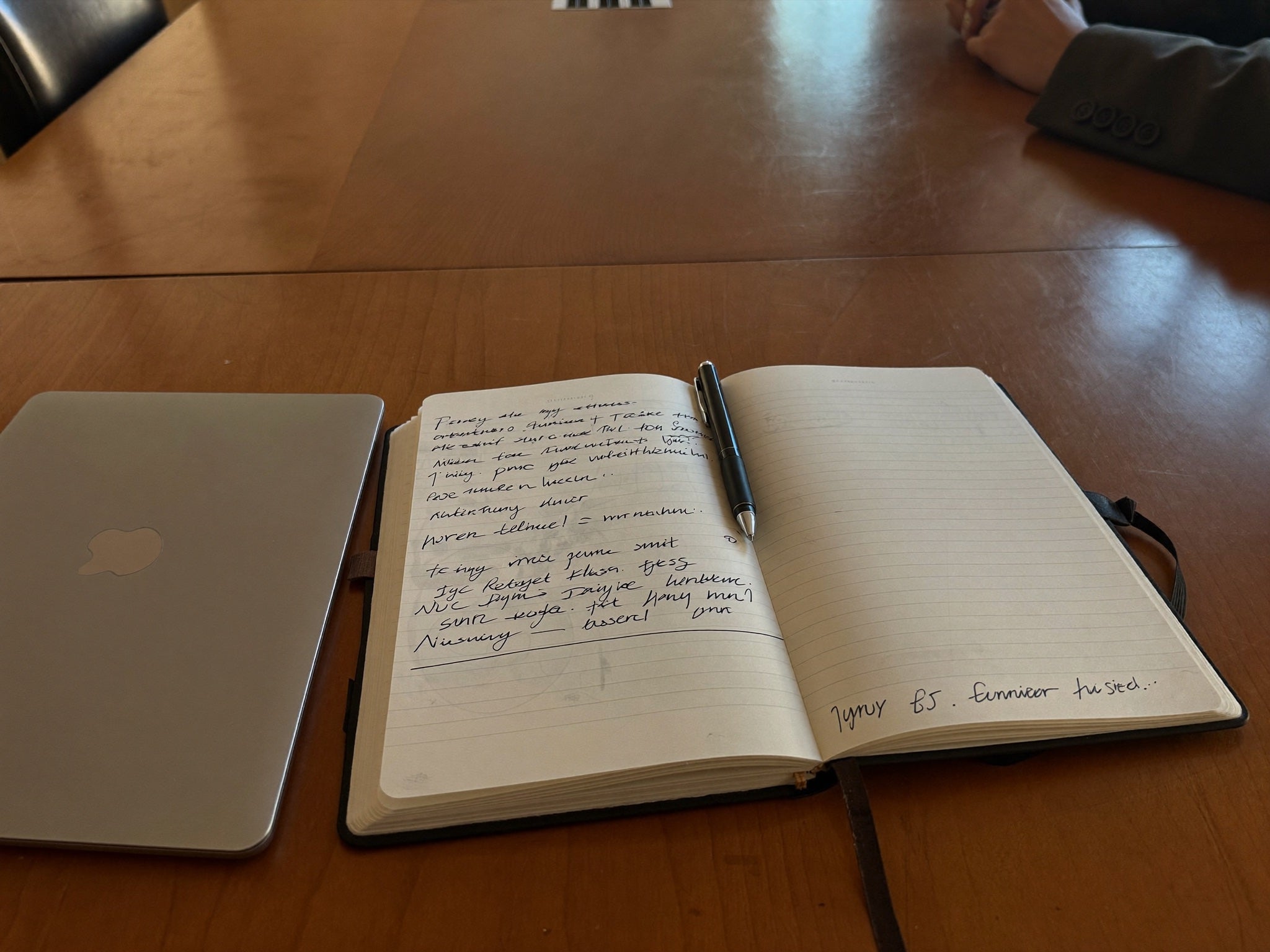
An open notebook with handwritten ink notes on a wooden desk, a phone beside it showing a meeting transcript
See If the $199 Starter Set Is Still Available

Click above to confirm the 30-day return window is still being offered.

I Had a System for Everything

Pre-meeting prep the night before. A specific notebook. Color coded sections. Voice memos taken in the elevator between the meeting room and my desk because I had learned, the hard way, that the walk back was long enough for things to disappear.

My job was to capture what happened in rooms. The summary. The action items. Who said what and what they agreed to do about it.

I was methodical about this. Genuinely methodical. I tried probably every tool that existed, seventeen apps at one point across three devices, a smart notebook my brother gave me that was supposed to scan my handwriting into searchable text, audio transcription software that returned clean records I still could not properly use. I built workarounds on top of workarounds.

The recaps still went out with gaps I could not always explain.

For a long time I assumed this was just how the job worked. That meeting documentation was inherently difficult and the best you could do was manage it carefully.

I was solving the wrong problem.

What a Four-Minute Conversation in a Hotel Lobby Changed

Last spring I was at a workplace productivity conference in Austin. I was walking through the lobby when I caught the end of a conversation and stopped.

A cognitive scientist was talking to a small group near the entrance. I only heard four minutes of it. I have been thinking about those four minutes ever since.

She was talking about how the brain stores information from meetings. Not the way most people describe it, she said. Not as a filing system. The brain stores moments. Associations.

When something happens in a room, your brain does not file the words alone. It files everything that was happening at that exact second alongside the words: what your hand was doing, the sounds in the space, the order things occurred. All of it together on the same timeline.

"When you try to recall a meeting later," she said, "you are not actually searching for words. You are searching for the context those words were attached to when they arrived."

I asked what happens when that context is missing.

She looked at me. "Most tools separate the context that helps people reconnect with what happened."

I stood there for a second and thought about my seventeen apps.

The transcription software had the audio. The smart notebook had the handwriting scan. The note app had typed text. Three different places. Three different tools that had never been designed to talk to each other.

The Part Nobody in This Industry Wants to Say

Research on how professionals retain spoken information consistently shows that meeting details begin fading within hours of the conversation ending, often before the summary has even been drafted.

This is not about effort or attention. It is structural.

Memory anchors to context. Information captured without multiple simultaneous inputs (the audio alongside what was being written, in the order it happened) becomes harder to retrieve later regardless of how carefully it was recorded at the time.

The note-taking market has known this for decades and kept building products that solve one piece anyway.

The smart notebook category captures handwriting. The transcription category captures audio. The note app category captures typed text. Each one presents its single piece as a complete solution.

None of the existing categories had been built to keep all three together. That is the gap. And for a long time, nobody had tried to close it.

"Most tools separate the context that helps people reconnect with what happened."— The cognitive scientist's framing

Priya's Notebook

About six weeks after Austin I had coffee with a colleague named Priya. We had worked together at a previous company a few years back. She had moved into a more senior role since then and I had noticed, without ever saying anything, that her post-meeting summaries were consistently better than mine. More complete. Faster. The kind of recap that made it clear the person writing it had actually been in the conversation.

She put a notebook on the table between us. Looked ordinary. Black cover, slim pen beside it.

I asked what it was.

"Honestly it is the reason I stopped dreading Monday mornings," she said.

She explained it. She writes with real ink on real paper: actual ballpoint, actual pages. As she writes, every stroke syncs to an app in real time. The app is also recording the meeting audio and identifying each speaker. When the meeting ends, she has one session containing her handwritten pages, the full audio transcript, and an AI summary that pulled from both.

Handwriting and audio on the same timeline. Not separate. Together.

She pulled out her phone and searched for something she had written three months earlier. A page came up. The handwriting and the transcript context from the exact moment she had written it.

The association her brain had been trying to build was there. Intact.

It is called XNote. I asked her to send me the link before we finished our coffee.

The First Meeting

I used it the following Tuesday. Standard cross-functional sync. Twelve people. I wrote the way I always write, which is to say, a little too fast and not always legibly. I pressed the button on the app. I did not change anything else about how I work.

The meeting ended at 10:30. I went to my desk, opened the app.

My handwritten pages were there. The transcript was there with each speaker labeled. The AI had already built a summary combining both.

I sent the recap to twelve people at 10:47.

That part had never happened before. The sending was always later. There was always a gap between the meeting ending and the summary going out where I was trying to piece things together.

This time there was nothing to piece. It was already done.

Four Months Later

The meeting documentation is better. That is the simple version.

The longer version is that the system of workarounds I had built over six years (the pre-meeting rituals, the elevator voice memos, the color coded notebooks, the backup processes) gradually became unnecessary. Not because I decided to stop. Because the gap they had been compensating for no longer existed.

Three weeks in I searched for something I had written in a different context months earlier. I typed a word I remembered. The app returned a page where I had written a completely different word with the same meaning. The semantic search had understood what I meant without my explaining it.

Notes I had written over the previous year were suddenly retrievable in a way they had not been before. Not because the notes had changed. Because the context that connected them to everything else was finally in the same place.

Why You Have Not Found This Already

Before Priya showed me XNote I had searched for it. Smart notebook. AI meeting capture. Paper to digital. Handwriting search. Meeting transcription tools.

It did not come up.

XNote sits between the smart notebook category, the meeting transcription category, and the AI note app category. Standard searches return products that address one of those three. XNote was built around the relationship between all three. There is no shelf for that. So it does not appear on any shelf.

Priya found it because a colleague sent her the link. Not from a search. Not from a platform recommendation. A direct link from someone who had already found it.

That is what I am doing now.

What Is Included

The XNote Starter Set is $199 one-time.

The box includes the smart pen, the smart notebook with the dot-pattern paper, the companion app on iOS, Android, and web, and the audio capture features that turn every meeting into one searchable session.

Core handwriting digitization, search, AI Chat with your notes, summaries, flashcards, translation, and integrations with Google Calendar, Todoist, Slack, and 5,000+ apps via Zapier are all included from day one. No subscription required for any of it. The only thing the optional subscription gates is monthly audio transcription minutes; the free Starter plan that ships with the hardware includes 150 minutes per month.

Free shipping available in selected regions. Check availability at checkout.

30-day return window. Full refund if it does not work for you.

"Being able to leverage the power of conversational AI to maximise utility of the XNote note writing system is a total game changer. I have generally found the conversion of handwriting to text to be really excellent. And make no mistake, my handwriting is no calligraphy. That means you have computer-readable text accessible to the power of AI. I just love XNote."— Loman B., verified buyer
"I really like being able to hand write notes and having them easily searchable without having to first convert them to text, even though the OCR functionality is available if that's what you want, and it converts surprisingly well."— Scott, verified buyer
"Such a great tool for taking notes. I have a reMarkable as well but missed the feel of having a real notebook, so I thought I'd try this out. I find the XNote much quicker and more accurate when it converts to text. And the AI side is amazing."— Amanda S., verified buyer
See If the $199 Starter Set Is Still Available

Click above to confirm the 30-day return window is still being offered.